Today was not a writing day…
Thanks to Brittney for all the help cutting out our zombie assistant professors. If this isn’t spooky I don’t know what is! Come on psychology door decoration contest!
First off, I can’t say enough awesome things about Dr. Joe Currin. We’re lucky to have had him join us at TTU. I (along with Brittney) am doing some really cool collaborations with him: we are developing a behavioral theoretical orientation scale and exploring how orientation and considerations of ‘what supervision is’ plays a role in predicting supervisee perceived outcomes. We are also working on a multi-site resiliency project that includes a cross-cultural examination of the Integrative Hope Scale (we’re planning to look at invariance across ethnicity, sexual orientation, and gender).
Otherwise, here are some quick updates
So many more, but that’s enough for now!
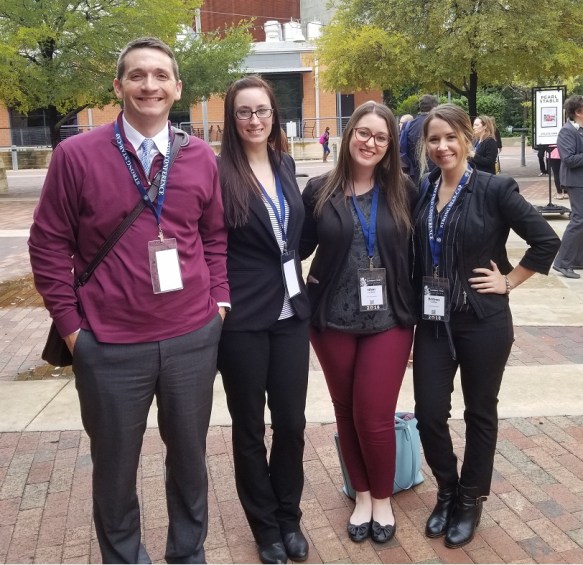
What a great conference to attend with the lab. Simply put, Strong Star puts on awesome conferences and we had a blast in San Antonio – so many awesome speakers talking about the future of PTSD treatment. As we carpooled down we talked a lot about next steps in the lab, so I wanted to highlight some products folks in the lab are part of/planning to submit over the next month that align with what we learned at the 3rd Annual Combat PTSD.
Brittney (my fantastic first year student) is going to be submitting as a first author a paper to APA evaluating the behavioral correlates for the MMPI-2-Restructured Form (MMPI-2-RF) RC3 (Cynicism) and RC9 (Hypomanic Activation) scales in a college student sample (after all, shouldn’t our evidence-based assessments predict behavior?!). She is also working with me on submissions for APA and AACN, looking at MMPI-2-RF validity scale efficacy in a U.S. Army concussion clinic, which explore the role of moderators (e.g., diagnosis, sex, etc.; Ingram & Ternes, 2016; Sharf et al., 2017; Ingram et al., 2018) and the general efficacy of the over reporting scales.
Nikki (although not my advisee I’m super lucky to have her working with me for a second year running) will be submitting a poster to APA on the results of our simulation study of PTSD/mild Traumatic Brain Injury/comorbidity on the MMPI-2-Restructured Form (MMPI-2-RF) validity scales.
Tara (an awesome undergrad RA in every way) came up with an awesome research question while running participants and will be submitting a poster to APA. While moderators have generally focused on demographic charactersistics, Tara was curious if trait characteristics (especially cynicism) influence testing response bias and is taking the lead on a really cool project. I love seeing my undergrad RAs take this sort of killer initiative and generate such thought provoking questions.
There are a few other submissions going out as well, including those looking at stigma and treatment seeking (as well as the development of a GOOD theoretical orientation scale). I’ll tell you more about those next!
Following the the lab’s pilot research (see Ingram, Cribbet, and Schdmit, 2018) on assessment training and educational outcomes in health service psychology, Dr. Schmidt and I have submitted a grant to evaluate these trends across the nation in all APA-approved programs. We hope our work will inform health service psychology training and promote a more empirically-based approach to psychological assessment. We’re very excited for what this project can contribute to graduate education and training in our field, so keep your fingers crossed! It’s time to make sure our profession gets the training support and emphasis needed to be successful.
#BetterScience
#BetterPsychology

Thanks to the awesome Dr. Joe Currin for making our amazing lab logo!
There is also so much going on as well in the lab for both assessment research and the treatment seeking work. I have several papers out right now on the MMPI-2-RF, much of it based on the papers we have presented in the last at the MMPI symposium (such as this, this, and this). I’m also working with Brittney and Nikki Brittney and Nikki on another paper we plan to submit shortly that is evaluating PTSD assessment tools. Likewise, several undergraduates are joining in the lab to help us collect data and one has even started to put together an exciting research proposal based on available data (more to come soon on that!). Although the grant to evaluate PTSD in an incarcerated minority youth sample wasn’t funded this summer, Dr. Adam Schmidt and I received a very favorable review and an invited re-submission next year and we are looking forward to that in a few months from now.
As for stigma and treatment seeking research, data collection for the gender roles and Latinx project is ongoing. Recruitment picked up this year and are in talks about poster submissions using that data at APA. Data collection on stigma and health behaviors in response to physical pain ended last spring and Dr. Shinye Kim and I are in the midst of analysis. More to come!
I can’t believe I’m starting year two as an assistant professor already! This one is going to be a busy year for sure and I’m excited to have my new advisee Brittney Golden joining the lab. I just got out of several meetings today and there are some exciting research projects going this fall. Also, I anticipate taking a student next year (2019-2020 maturation) and am looking forward to hearing from potential applicants.
Just around the corner this fall is the Combat PTSD conference in San Antonio and my colleagues and I have two poster presentations going.
After that it’s on to preparing submissions for APA. The lab is trying hard to get enough data for our comorbidity feigning study to allow us to present that data at the conference. We’ve got some other fun things we’re going to try and send out over the next few months (papers and presentations).
Today was a busy day for MMPI Research with a lot of exciting progress.
The Validity Scale Presentation from the 7-year MMPI-2-RF sample from VAs around the country that will be presented in two weeks at the 2018 MMPI symposium has been finished. This presentation examines validity scale response style within the VA and there are some of the big conclusions from the presentation.
The other update? I submitted a grant to the University of Minnesota Press Test Division to evaluate MMPI-A-RF responses within a justice involved sample here in Texas. This project is in collaboration with Dr. Adam Schmidt in the Clinical program here at TTU and has three aims: (1) expand information available about adolescent forensic evaluations, (2) increase sampling of diverse and minority status youth, and (3) explore the relationship of the MMPI-A-RF scales to PTSD and within a trauma-exposed sample.
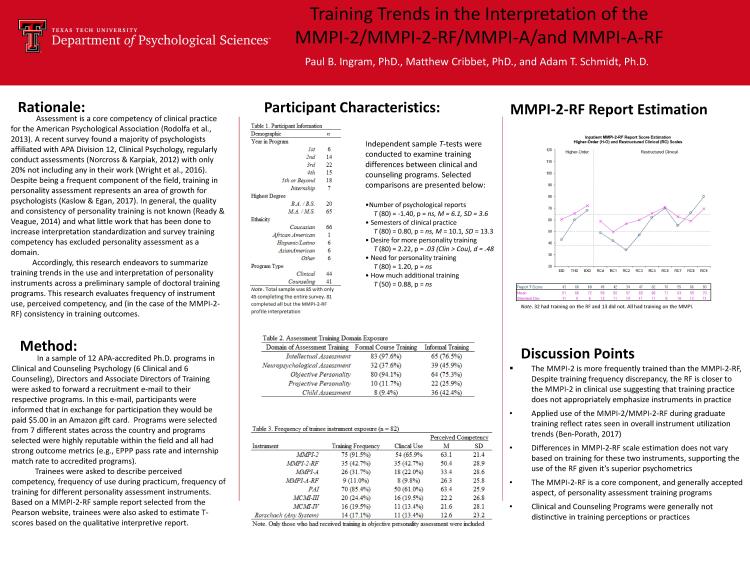
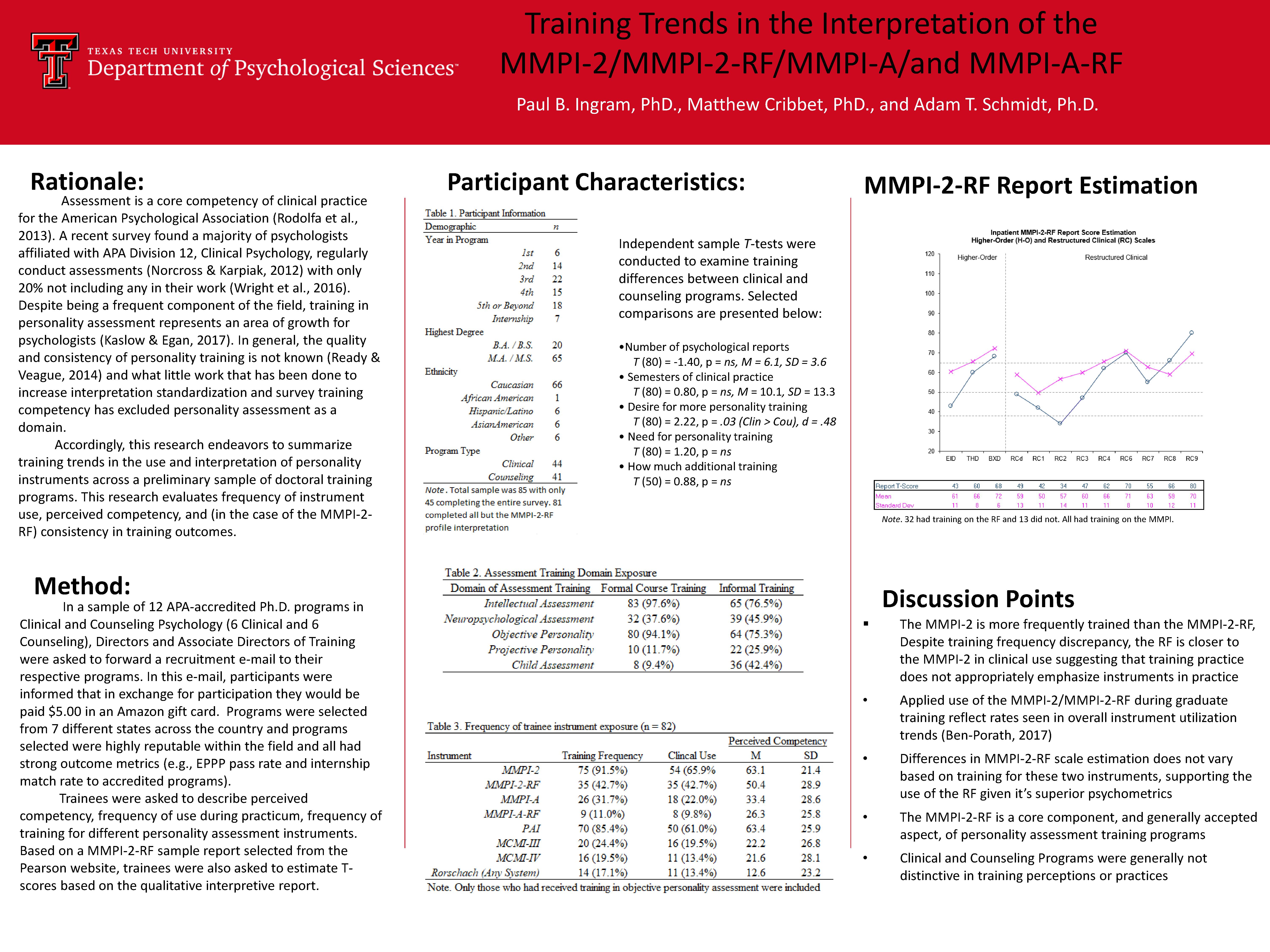
Some colleagues and I here at Texas Tech are taking a look at training trends in assessment (Click me for the presentation PPT) and the implications that has for the validity of instrument use. After all, if scales are valid indicators of their intended constructs but are not used appropriately or consistently (especially during graduate school when supervision and feedback is the highest/the material the most fresh) then there should be concerned about how this translates into practice, subsequent to graduation. The poster being presented in two weeks is taking a look at personality instruments specifically and there are a few things to note:

Disclaimer: Data here represents a preliminary analysis of the project and cover only selected thematic results. Results here are consistent with those seen in the full sample. Full results are being prepared for paper and will follow in a subsequent post in the future.
Personal Impression from results: As a field, we cannot focus exclusively on scale validity/treatment efficacy/etc. to ensure that training of those topics is sufficient. There needs to be an APA-led initiative on training standards so that we can ensure fidelity and adhere to our role as social scientists.
Below are the presentations being presented this year by the lab. If you will be at APA or the MMPI symposium, come see what we’re doing in person.
Ingram, P.B., Tarescavage, A.M., Ben-Porath, Y.S., & Oehlert, M.E. (2018, April). The MMPI-2-Restructured Form (MMPI-2-RF) Validity Scales: Patterns Observed across Veteran Affairs Settings. Paper accepted at the 2018 MMPI-2-RF/MMPI-2/MMPI-A-RF/MMPI-A Conference.
Ingram, P.B., Cribbet, M., & Schmidt, A.T. (2018, April). Training Trends in the Interpretation of the MMPI-2/MMPI-2-RF/MMPI-A/and MMPI-A-RF. Poster accepted at the 2018 MMPI-2-RF/MMPI-2/MMPI-A-RF/MMPI-A Conference.
Ingram, P.B., Parkman, T.J., Staggs, B., & Ternes, M.S. (2018, August). The MMPI-2-RF over-reporting scales: A meta-analysis of criterion-grouped clinical samples. Poster accepted at the 2018 American Psychological Conference.
The MMPI-3 is the next step because the dated psychometric standards that the MMPI/MMPI-2 are based on can’t continue to guide our interpretation of personality constructs. They simply don’t align to modern psychometric practice or to contemporary understanding of what personality is/how it is structured. The concerns outlined in this article do a poor job of representing the literature and I would have expected more from a commentary about the future of the most popular personality instrument. The author doesn’t even cite the rebuttals to the criticisms of the RF, leading the article to be poorly balanced. The RF isn’t perfect and there are numerous ways in which it needs to be refined (e.g., validity scale moderation and detection rates per Ingram & Ternes, 2016). There are also tons of important clinical constructs that aren’t measured (Borderline Personality, etc.), but these patterns are true of the MMPI-2 as well, in addition to the other issues (subtle items add noise not precision, poor homogeneity of scale constructs, etc.). Of course financial and market-based decisions influence these types of advancements, but from a practical standpoint- the RF outperforms the MMPI-2.
The truth is that the MMPI-3 is coming and it needs to. There are problems with the item set that the RF is constructed from – it needs to broaden and that means moving farther from the context of the MMPI-2. This move will allow opportunity to correct some of the issues inherent to the current scales and should allow better alignment to psychometric and psychopathology theory. Transitions aren’t without problems and advancement isn’t always universal, but it is impossible to ignore that the age of the MMPI-2 is past.