Below are some select recent papers (Fall til nowish) I’ve been on, many of them still in press at this time. I’m missing a few PDFs I’ve become aware in making this page, so I will update it. There are a number of older papers from 2025 publication that are not included here for brevity and time. I will be updating this page with a full catalog of my publications this summer for easier browsing and access.
| Project | Summary |
| Herring & Ingram (in press) | In this paper, we evaluate and review how the APA ethics code intersects with Artificial Intelligence in the domain of Psychological Assessment. We discuss these gaps, offer recommendations, and hypothesize about ways in which GenAI may be used to meet emerging needs of client and clinicians from the perspective of Counseling Psychology. |
| Herring, Rogers, & Ingram (in press) | In a longitudinal (1yr) assessment-focused paper evaluating adolescent sibling dyads using the MMPI-A-RF and a host of cognitive, behavioral, and mental health data (parent, self, other). We examine ways in which multi-informant data may be harmonized to align with HiTop dimensions. |
| Shura, Rine, Ingram, Schroeder, & Armistead-Jehle (in press)) | Using a national population of Veterans assessed in MHA 2008-2024 (n~6000), we examine the MCMI validity scales and their same day relationship to the MMPI-2-RF |
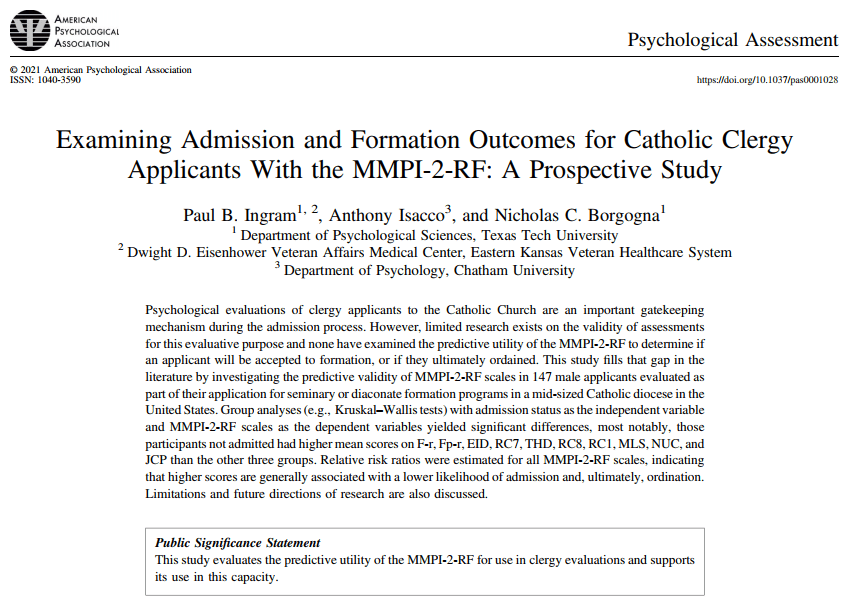
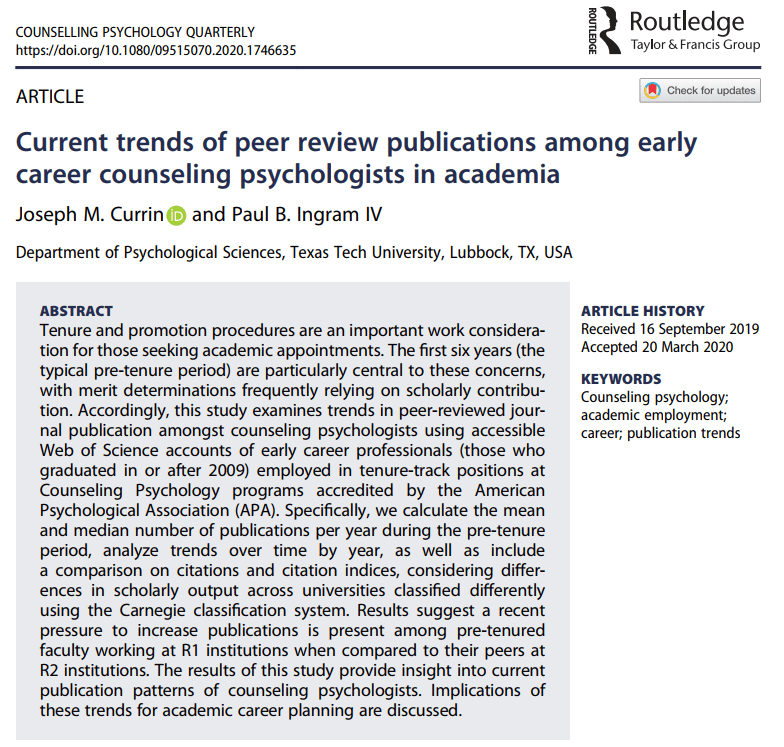
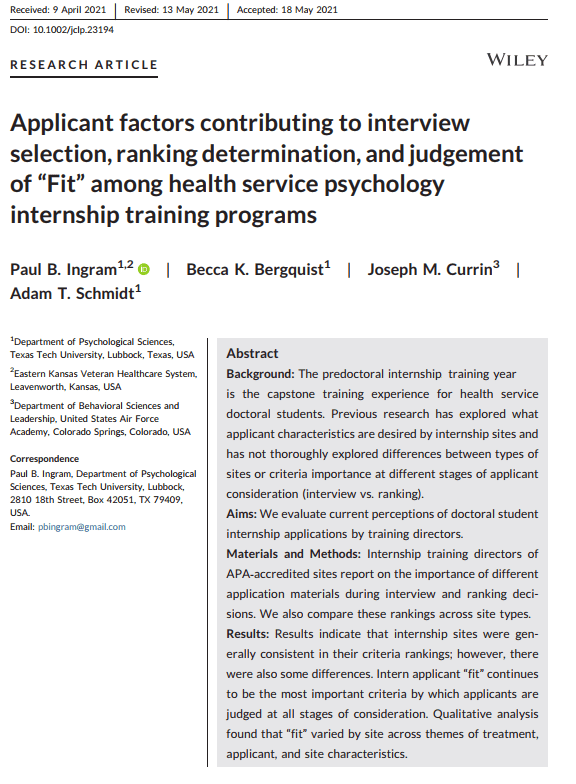
| Parent & Ingram (2026) | In this study, we examine business training of health service psychologists in relation to career intention and training elements. |
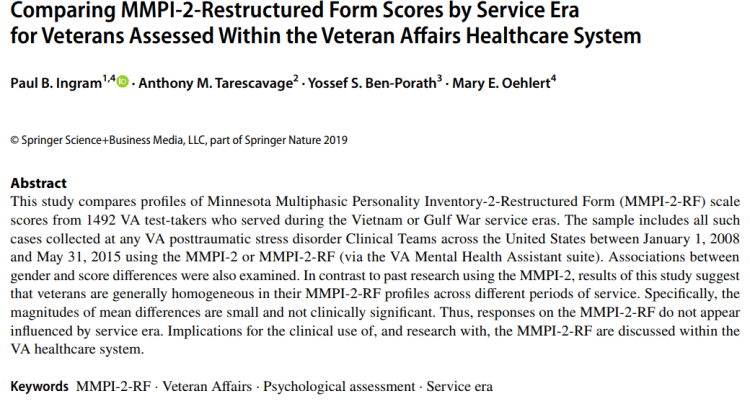
| Diehl, Herring, Albertorio, Ingram, & Pagano (in press a) Diehl, Herring, Ingram, Pagano, & Gideon (in press b) | In this two paper series, we examine how (1) compensation and pension / Service Connection and (2) Service Era impact assessment profiles, building on existing work examining ways to improve assessment accuracy and reduce interpretive biases |
| Shura, Ingram, Schroeder, & Armistead-Jehle (in press) | Using a national population of Veterans assessed in MHA 2008-2024 (~30,000), we examine the Personality Assessment Inventory (PAI) validity scales and evaluate rates of performance to establish standard population base rate norms. |
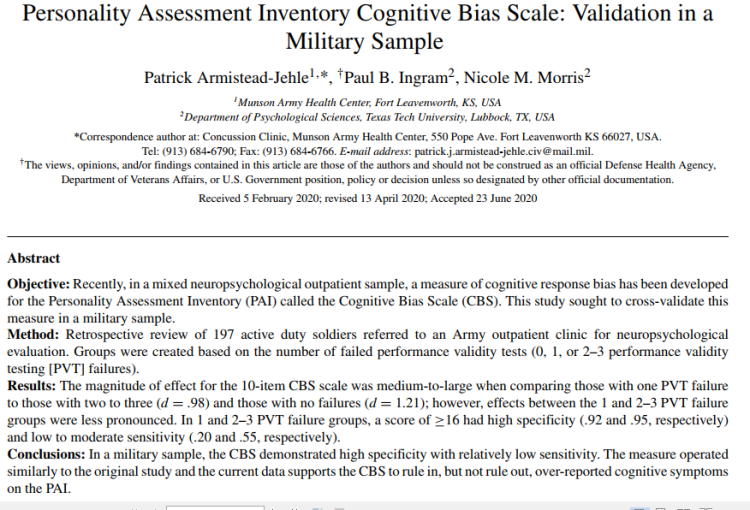
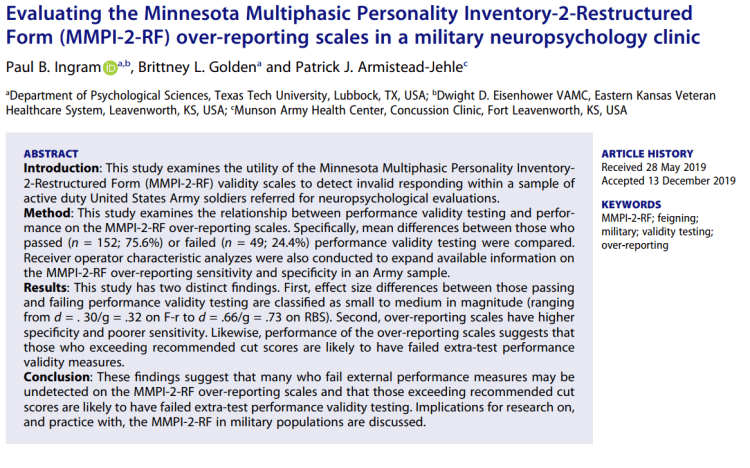
| Aita…Ingram, et al. (2026) | A recent issue with the detection of invalidity of symptom profiles is that many scales function similarly. As a result, this base-rate approach to validate determinations examines its potential using a multi-population sample including Department of Defense and Department of Veteran Affairs persons. |
| Victor, Mitchell, & Ingram (in press) | In a longitudinal sample of depressed and highly suicidal college students (50% active ideation and past attempts), we examine how the depression, self-criticism, and NSSI relate to one another over the course of a few months. |
| Victor, Bianco, McClay, & Ingram (in press) | In this study, we created a new scale to measure the Public Stigma of Nonsuicidal Self-Injury (STONSI) scale. This study included two samples, including a longitudinal high risk depression sample (see Morris et al., 2023). |
Underlined names are graduate or undergraduate students.
Lab Research Focus
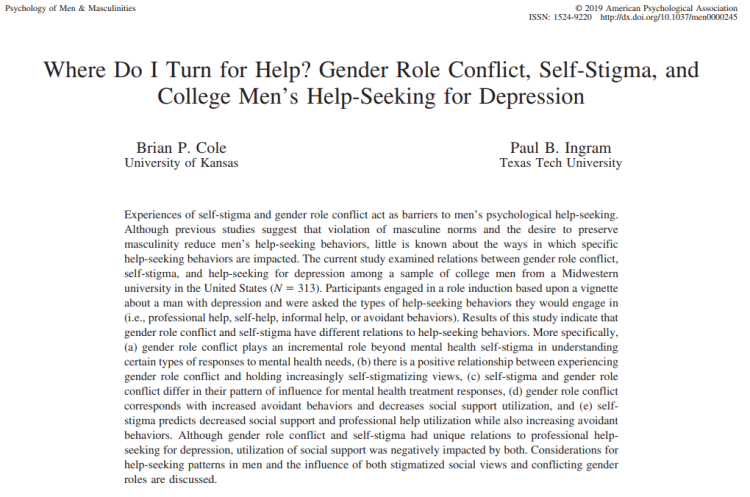
The lab’s research focuses on: (1) advancing evidence-based assessment and (2) barriers to engagement and retention in mental health services. These areas are generally centered on military and trauma exposed populations, and approach problems from a psychometric (math) perspective that prioritizes validity and real world impacts. My research on assessment is process oriented, meaning that I view assessment validity in terms of both a function of correlational and cross-sectional investigations assessing instrument relationship to criterion factors (i.e., where most assessment research falls and that which emphasizes detecting/improving error in scale construction – correlations, latent class analyses, factor analyses) as well as on the procedure of interpretation and application of instruments in training and practice settings (e.g., clinician interpretation, instrument use frequency, and barriers to use). Research on treatment focuses on understanding the process to get individuals into various types of help including both traditionally formal psychotherapy services, but also other supportive services (e.g., self-help). I increasing describe myself as a post-empiricist that embraces a critical lens to understanding complex relationships between and within conditions (see Assessment as a Spectacle).